
Nevada Truck Accident Laws and Claims Guide (2026)
$6,000,000
Truck Accident
$3,000,000
Truck Accident
$1,715,000
DUI Car Accident
$1,550,000
Truck Accident
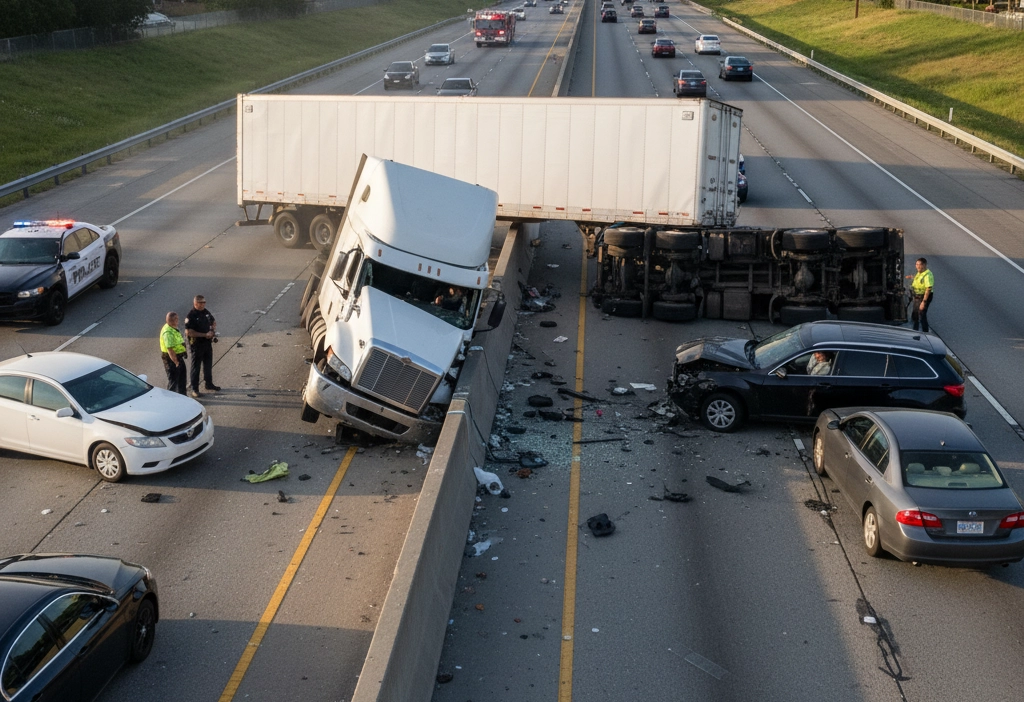
Truck crashes are not “just bigger car accidents.” In Nevada, commercial vehicle cases often involve multiple potentially liable parties, overlapping state and federal safety rules, specialized evidence (electronic logs, black box data, maintenance files), and higher insurance layers. This guide explains how Nevada truck accident claims work, what laws matter most, and what steps help protect your right to recover.
1) What counts as a “truck accident” case in Nevada
A Nevada “truck accident” claim typically involves a commercial motor vehicle such as:
- A tractor-trailer (semi, 18-wheeler)
- Box truck (delivery trucks, moving trucks)
- Dump truck, cement mixer, tow truck
- Work fleet vehicles and commercial vans
- Buses and passenger carriers (when operated as commercial carriers)
- Vehicles hauling hazardous materials
Many of these vehicles and companies are subject to the Federal Motor Carrier Safety Regulations (FMCSRs) in 49 C.F.R. Parts 382, 383, 385, 387, and 390–397, and Nevada has also adopted large portions of those federal safety regulations by reference for motor carrier safety enforcement in this state (NAC 706.297).
2) The biggest difference: truck cases are evidence cases
In most truck collisions, liability is proven through a combination of:
- What happened on the roadway (speed, lane changes, following distance, right of way).
- Driver condition and conduct (fatigue, distraction, impairment, training, decision-making).
- Company-level decisions (safety culture, dispatch pressure, hiring standards, supervision).
- Vehicle condition (brakes, tires, lights, underride protection, maintenance, inspection history).
- Federal and state safety rule compliance (hours-of-service, inspections, post-crash testing, recordkeeping).
This matters because trucking evidence can disappear quickly under routine retention policies, so acting early is often the difference between a strong case and an avoidable fight over missing records.
3) Key Nevada deadlines you cannot ignore
Personal injury statute of limitations
Most Nevada truck accident injury claims must be filed within two years (NRS 11.190(4)(e)).
Wrongful death statute of limitations
Wrongful death claims are generally subject to a two-year limitations period as well (NRS 11.190(4)(e); NRS 41.085).
Property damage statute of limitations
Property damage claims are commonly governed by a three-year limitations period for injury to personal property (NRS 11.190(3)(c)).
Practical point: Waiting is dangerous in truck cases even when the statute of limitations is two years, because key records may be retained for far less time under federal rules (see Section 7).
4) Who can be liable in a Nevada truck accident
Truck cases often involve multiple defendants, and Nevada law allows you to pursue each entity whose negligence contributed to the crash.
A. The truck driver
A driver may be liable for negligent driving, including fatigue, distraction, speeding, unsafe lane changes, or driving while ill or too tired to operate safely. Federal rules specifically address fatigue-related safety concerns (49 C.F.R. § 392.3).
B. The motor carrier or trucking company (vicarious liability)
Nevada recognizes vicarious liability when an employee is acting within the scope of employment. Whether conduct is within the scope depends on the facts, including whether the employee’s conduct was for the employer’s benefit and under the employer’s control (Evans v. Southwest Gas Corp., 108 Nev. 1002, 842 P.2d 719 (1992); Molino v. Asher, 96 Nev. 814, 618 P.2d 878 (1980)).
In plain terms: if the driver was driving for work, the company may be responsible for the driver’s negligence under respondeat superior.
C. The motor carrier or trucking company (direct negligence)
Even if a company admits the driver was working, truck cases frequently include direct negligence claims against the company, such as:
- Negligent hiring (e.g., hiring a driver with a known bad record or disqualifying history).
- Negligent retention (keeping an unsafe driver after red flags).
- Negligent training and supervision (inadequate training, weak safety enforcement).
- Negligent safety policy and dispatch pressure (improper scheduling contributing to fatigue).
Nevada recognizes claims based on an employer’s failure to use reasonable care in hiring and related employment decisions (Burnett v. C.B.A. Sec. Serv., Inc., 107 Nev. 787, 820 P.2d 750 (1991); Hall v. SSF, Inc., 112 Nev. 1384, 930 P.2d 94 (1996); Freeman Expositions, LLC v. Eighth Judicial Dist. Ct., 138 Nev. Adv. Op. 77, 520 P.3d 803 (2022)).
D. Negligent entrustment (driver should not have been behind the wheel)
Nevada recognizes negligent entrustment where the owner or controller of a vehicle entrusts it to a person they know, or should know, is incompetent or unfit to operate it safely (Zugel by Zugel v. Miller, 100 Nev. 525, 688 P.2d 310 (1984); Connell v. Carl’s Air Conditioning, 97 Nev. 436, 634 P.2d 673 (1981)).
This theory is common when the driver is unqualified, medically unfit, has substance-abuse issues, or has a record showing dangerous driving, and the company or owner still allowed them to drive.
E. Maintenance vendors, repair shops, and parts suppliers
A crash may be caused or worsened by brake failure, tire failure, lighting problems, or other mechanical defects. Depending on the facts, liability may extend to:
- The entity responsible for maintenance and inspections
- A repair shop that performed negligent repairs
- A manufacturer (product liability theories are fact-specific and technical)
F. Trailer owners, brokers, shippers, and loaders
Some crashes involve unsafe loading (shifted cargo, overweight loads) or trailer/tractor mismatches. Liability may attach to parties who controlled the load, trailer condition, or safety decisions, depending on evidence and the contractual relationships.
5) How trucking safety rules affect negligence in Nevada
A. Standard negligence still applies
Most truck accident cases are negligence cases: duty, breach, causation, and damages.
B. Negligence per se can be powerful, but must fit the rule
Nevada recognizes that violating a safety statute can establish duty and breach under negligence per se if the injured person is in the protected class and the harm is the type the law was meant to prevent (Sagebrush Ltd. v. Carson City, 99 Nev. 204, 660 P.2d 1013 (1983); Ashwood v. Clark Cnty., 113 Nev. 80, 930 P.2d 740 (1997); Anderson v. Baltrusaitis, 113 Nev. 963, 944 P.2d 797 (1997)).
Negligence per se issues are often jury questions in Nevada, depending on the facts and whether the statute/regulation applies (Zugel by Zugel v. Miller, 100 Nev. 525, 688 P.2d 310 (1984); Anderson v. Baltrusaitis, 113 Nev. 963, 944 P.2d 797 (1997)).
C. FMCSRs matter because Nevada adopts many of them for carrier safety enforcement
Nevada adopts significant federal motor carrier safety regulations by reference (NAC 706.297). That creates practical, case-driving consequences:
- Safety regulations can frame what “reasonable care” requires in commercial operations.
- Violations can support negligence theories, depending on how the court applies Nevada negligence-per-se principles and the facts of the crash.
6) The core FMCSA rules that come up in Nevada truck crash cases
Below are the federal rule categories that commonly drive liability investigations:
A. Hours-of-service and fatigue
- Driving time limits for property-carrying drivers (49 C.F.R. § 395.3).
- Electronic logging and record-of-duty status requirements (49 C.F.R. § 395.8; 49 C.F.R. § 395.11).
- Drivers may not operate a commercial motor vehicle when their ability is impaired by fatigue or illness (49 C.F.R. § 392.3).
B. Driver qualification and medical fitness
- Driver qualification file requirements and contents (49 C.F.R. § 391.51).
- General driver qualification standards are covered in 49 C.F.R. Part 391.
C. Drug and alcohol testing
Post-crash testing duties can become critical evidence issues in serious collisions (49 C.F.R. § 382.303).
D. Inspections, repair, and maintenance
- Systematic inspection, repair, and maintenance rules (49 C.F.R. § 396.3).
- Driver vehicle inspection reports and retention requirements (49 C.F.R. § 396.11).
- Periodic inspection requirements (49 C.F.R. § 396.17).
- Periodic inspection report recordkeeping and retention (49 C.F.R. § 396.21).
E. Distracted driving rules (commercial drivers)
FMCSRs include restrictions on texting and handheld phone use for commercial drivers (49 C.F.R. § 392.80; 49 C.F.R. § 392.82).
F. Minimum insurance requirements
Many interstate carriers must meet federal minimum financial responsibility requirements, which vary by operation and cargo type (49 C.F.R. § 387.9). In practice, many motor carriers carry layered coverage, including primary and excess policies, which can affect settlement dynamics.
7) Evidence preservation: what to demand, and why timing matters
A. Trucking records often have short mandatory retention windows
Even when a crash is catastrophic, companies may still follow routine retention schedules unless they are placed on clear notice to preserve.
Common federal retention rules include:
- Accident register: must be maintained 3 years (49 C.F.R. § 390.15(b)).
- Driver qualification file: retained while employed and 3 years thereafter (49 C.F.R. § 391.51(c)).
- Hours-of-service records and supporting documents: retained 6 months (49 C.F.R. § 395.8(k)(1)).
- Maintenance records: retained 1 year and 6 months after the vehicle leaves the carrier’s control (49 C.F.R. § 396.3(c)).
- Periodic inspection report: retained 14 months (49 C.F.R. § 396.21(b)(1)).
- Driver vehicle inspection reports (DVIRs): retained 3 months (49 C.F.R. § 396.11(c)(4)).
Why this matters: If you do nothing for months, critical records (especially logs and supporting documents) may be lawfully destroyed under ordinary policies. Preservation letters and early legal action are often necessary in truck cases.
B. Key evidence categories in a Nevada truck accident case
A serious truck crash investigation commonly seeks:
Driver and trip evidence
- ELD data and logs
- Dispatch records and load assignments
- GPS data, route history, geofencing pings
- Cell phone data, in-cab communications
- Bills of lading, trip sheets, weight tickets
Safety and employment evidence
- Driver qualification file (DQF)
- Prior crashes, citations, safety violations
- Training records and safety meeting attendance
- Drug/alcohol testing compliance and policies
Vehicle evidence
- Maintenance and repair history
- Brake, tire, and inspection records
- DVIRs and repair certifications
- Black box/ECM/EDR data (where applicable)
- Dash camera or inward/outward-facing camera footage
- Post-crash inspection reports
C. Nevada spoliation principles and sanctions
Nevada courts have the authority to sanction parties who fail to preserve evidence, including through discovery sanctions (NRCP 37). Nevada case law recognizes that evidence destruction can justify sanctions and adverse consequences (Stubli v. Big D Int’l Trucks, Inc., 107 Nev. 309, 810 P.2d 785 (1991); Fire Ins. Exch. v. Zenith Radio Corp., 103 Nev. 648, 747 P.2d 911 (1987)).
Nevada also recognizes a disputable presumption that evidence willfully suppressed would be adverse if produced (NRS 47.250(3)). Nevada decisions have addressed what “willful suppression” means and when adverse inference instructions are appropriate (Reingold v. Wet ‘N Wild Nevada, Inc., 113 Nev. 967, 944 P.2d 800 (1997); Bass-Davis v. Davis, 122 Nev. 442, 134 P.3d 103 (2006); Paley v. Desert Palace, LLC, 566 P.3d 561 (Nev. 2025) (order of affirmance)).
Practical point: In truck cases, a preservation letter should be sent immediately, and it should specifically list electronically stored information (ESI) such as ELD data, ECM data, camera footage, Qualcomm/telematics messages, and dispatch communications.
8) Comparative fault and “multiple defendant” realities in Nevada
Nevada follows a modified comparative negligence framework (NRS 41.141). Practically:
- Your compensation can be reduced by your percentage of fault (NRS 41.141).
- In multi-defendant cases, Nevada’s rules on allocation of fault make it critical to identify every responsible actor and prove their role (NRS 41.141).
In truck cases, defense teams often try to shift fault to the injured person, another driver, a phantom vehicle, a road condition, or a third-party maintenance provider. A thorough investigation is how you prevent unfair fault shifting.
9) Damages in Nevada truck accident cases
Truck collisions often cause life-altering harm. Nevada damages typically fall into:
A. Economic damages
- Past and future medical expenses
- Lost wages and loss of earning capacity
- Rehabilitation and assistive care
- Property damage and out-of-pocket losses
B. Non-economic damages
- Pain and suffering
- Emotional distress
- Loss of enjoyment of life
- Disfigurement and impairment
C. Wrongful death and survival damages
When a crash is fatal, Nevada’s wrongful death statute governs who can recover and what damages may be available (NRS 41.085). Nevada also provides for survival of certain claims (NRS 41.100).
D. Punitive damages (when conduct is more than ordinary negligence)
Punitive damages may be available when proven by clear and convincing evidence that the defendant acted with oppression, fraud, or malice, subject to statutory rules and limitations (NRS 42.005). Nevada also has specific provisions addressing punitive damages in vehicle cases involving alcohol or other substances (NRS 42.010).
If punitive damages are pursued against an employer for an employee’s wrongdoing, Nevada imposes limitations and requirements, especially for corporate employers (NRS 42.007). Nevada punitive damages doctrine is heavily fact-driven and can materially affect settlement posture in catastrophic truck cases (K Mart Corp. v. Ponsock, 103 Nev. 39, 732 P.2d 1364 (1987)).
10) The Nevada truck accident claim process: from crash to check
Every case is unique, but most successful truck cases follow a disciplined sequence.
Step 1: Medical care and documentation
Your health comes first. From a legal standpoint, consistent treatment and accurate records help establish causation and damages.
Step 2: Early investigation and preservation
This is where truck cases are won. Effective early steps include:
- Obtaining the crash report and scene evidence
- Preserving photographs, videos, and witness statements
- Sending a detailed preservation letter
- Securing data sources (camera footage, ECM/EDR, ELD, dispatch records)
Step 3: Identify all liable parties and insurance layers
Truck cases often involve primary and excess coverage, plus separate policies for brokers, owners, and contractors. This is one reason trucking settlements can be larger, but also more complex.
Step 4: Liability analysis using statutes, FMCSRs, and Nevada case law
Strong cases tie facts to legal standards:
- Negligence and causation analysis
- Negligence per se arguments where appropriate (Sagebrush Ltd. v. Carson City, 99 Nev. 204, 660 P.2d 1013 (1983); Anderson v. Baltrusaitis, 113 Nev. 963, 944 P.2d 797 (1997); Barnes v. Delta Lines, Inc., 99 Nev. 688, 669 P.2d 709 (1983)).
- Employer liability theories (Evans v. Southwest Gas Corp., 108 Nev. 1002, 842 P.2d 719 (1992); Burnett v. C.B.A. Sec. Serv., Inc., 107 Nev. 787, 820 P.2d 750 (1991); Hall v. SSF, Inc., 112 Nev. 1384, 930 P.2d 94 (1996)).
- Entrustment and hiring theories when the driver should not have been driving (Zugel by Zugel v. Miller, 100 Nev. 525, 688 P.2d 310 (1984); Connell v. Carl’s Air Conditioning, 97 Nev. 436, 634 P.2d 673 (1981)).
Step 5: Demand package and settlement negotiations
A thorough demand often includes:
- A liability summary grounded in law and records
- A medical chronology and itemized damages
- Supporting documentation, including expert support where needed
Step 6: Litigation (if the insurer refuses to be reasonable)
When settlement is not possible, a lawsuit may be necessary. Litigation typically involves:
- Written discovery
- Depositions of the driver, safety director, dispatch, and corporate witnesses
- Expert work (accident reconstruction, trucking safety, medical causation, life care planning)
Nevada expert admissibility and the reliability of expert support can become pivotal in larger injury cases (NRS 50.275; Hallmark v. Eldridge, 124 Nev. 492, 189 P.3d 646 (2008)).
Step 7: Mediation, arbitration (where applicable), or trial
Many cases resolve in mediation after meaningful discovery reveals the safety evidence. Others proceed to trial when liability or damages remain disputed.
11) Quick FAQs
How long does a Nevada truck accident case take?
It depends on medical recovery, the number of defendants, the quality of preserved evidence, and whether litigation is needed. Severe injury cases frequently require more time to document future care and earning loss.
Should I talk to the trucking company’s insurer?
Be careful. Statements can be used against you later. Truck cases are document-driven, and early misstatements can complicate liability and comparative fault arguments (NRS 41.141).
What if the trucking company says the driver was an “independent contractor”?
Labels are not always controlling. Liability can still exist through vicarious liability principles, negligent hiring/retention, negligent entrustment, and other direct negligence theories depending on control and facts (Evans v. Southwest Gas Corp., 108 Nev. 1002, 842 P.2d 719 (1992); Burnett v. C.B.A. Sec. Serv., Inc., 107 Nev. 787, 820 P.2d 750 (1991); Zugel by Zugel v. Miller, 100 Nev. 525, 688 P.2d 310 (1984)).
What if critical records are “missing”?
Nevada law allows courts to address evidence destruction through sanctions and adverse-inference principles when the facts support it (NRS 47.250(3); Stubli v. Big D Int’l Trucks, Inc., 107 Nev. 309, 810 P.2d 785 (1991); Reingold v. Wet ‘N Wild Nevada, Inc., 113 Nev. 967, 944 P.2d 800 (1997); Bass-Davis v. Davis, 122 Nev. 442, 134 P.3d 103 (2006)).
Nevada legal authorities cited
Nevada statutes and rules
- NRS 11.190(3)(c)
- NRS 11.190(4)(e)
- NRS 41.085
- NRS 41.100
- NRS 41.141
- NRS 42.005
- NRS 42.007
- NRS 42.010
- NRS 47.250(3)
- NRS 50.275
- NRCP 37
Nevada administrative law
- NAC 706.297
Nevada case law
- Anderson v. Baltrusaitis, 113 Nev. 963, 944 P.2d 797 (1997)
- Ashwood v. Clark Cnty., 113 Nev. 80, 930 P.2d 740 (1997)
- Barnes v. Delta Lines, Inc., 99 Nev. 688, 669 P.2d 709 (1983)
- Bass-Davis v. Davis, 122 Nev. 442, 134 P.3d 103 (2006)
- Burnett v. C.B.A. Sec. Serv., Inc., 107 Nev. 787, 820 P.2d 750 (1991)
- Connell v. Carl’s Air Conditioning, 97 Nev. 436, 634 P.2d 673 (1981)
- Evans v. Southwest Gas Corp., 108 Nev. 1002, 842 P.2d 719 (1992)
- Fire Ins. Exch. v. Zenith Radio Corp., 103 Nev. 648, 747 P.2d 911 (1987)
- Freeman Expositions, LLC v. Eighth Judicial Dist. Ct., 138 Nev. Adv. Op. 77, 520 P.3d 803 (2022)
- Hall v. SSF, Inc., 112 Nev. 1384, 930 P.2d 94 (1996)
- Hallmark v. Eldridge, 124 Nev. 492, 189 P.3d 646 (2008)
- K Mart Corp. v. Ponsock, 103 Nev. 39, 732 P.2d 1364 (1987)
- Molino v. Asher, 96 Nev. 814, 618 P.2d 878 (1980)
- Paley v. Desert Palace, LLC, 566 P.3d 561 (Nev. 2025) (order of affirmance)
- Reingold v. Wet ‘N Wild Nevada, Inc., 113 Nev. 967, 944 P.2d 800 (1997)
- Sagebrush Ltd. v. Carson City, 99 Nev. 204, 660 P.2d 1013 (1983)
- Stubli v. Big D Int’l Trucks, Inc., 107 Nev. 309, 810 P.2d 785 (1991)
- Zugel by Zugel v. Miller, 100 Nev. 525, 688 P.2d 310 (1984)
Federal regulations
- 49 C.F.R. § 382.303
- 49 C.F.R. § 387.9
- 49 C.F.R. § 390.15(b)
- 49 C.F.R. § 391.51(c)
- 49 C.F.R. § 392.3
- 49 C.F.R. § 392.80
- 49 C.F.R. § 392.82
- 49 C.F.R. § 395.3
- 49 C.F.R. § 395.8(k)(1)
- 49 C.F.R. § 395.11
- 49 C.F.R. § 396.3(c)
- 49 C.F.R. § 396.11(c)(4)
- 49 C.F.R. § 396.17
- 49 C.F.R. § 396.21(b)(1)
If you need assistance with your personal injury case, don’t hesitate to contact Friedman Injury Law.
Friedman Injury Law
375 N. Stephanie St., Ste. 1411
Henderson, NV 89014
P: (702) 970-4222
W: blakefriedmanlaw.com
PRACTICE AREAS
FRIEDMAN
Why Choose Friedman Injury Law
Blake S. Friedman brings years of personal injury experience to your case. As a Las Vegas native and the founder of Friedman Injury Law, Blake has dedicated his practice solely to personal injury law. He has secured over $50 million in settlements for clients across Nevada. Blake and our team prioritize client needs, keeping open communication throughout the legal process. We never recommend settlements below a case’s true value. With extensive courtroom experience and a commitment to fighting for our clients, we are fully prepared to represent you aggressively and help you recover the maximum compensation possible.
BLAKE S. FRIEDMAN, ESQ.
HAS RECOVERED OVER
$100,000,000
FOR HIS CLIENTS IN
LAS VEGAS AND ACROSS
SOUTHERN NEVADA
Speak With Our Las Vegas Personal Injury Lawyers Today
If you were hurt because someone else was careless, do not wait to get the legal help you need. The Las Vegas personal injury lawyers at Friedman Injury Law are ready to listen to your story, explain your options, and fight for the full compensation you deserve. Call (702) 970-4222 today to speak directly with our team and schedule your free consultation.